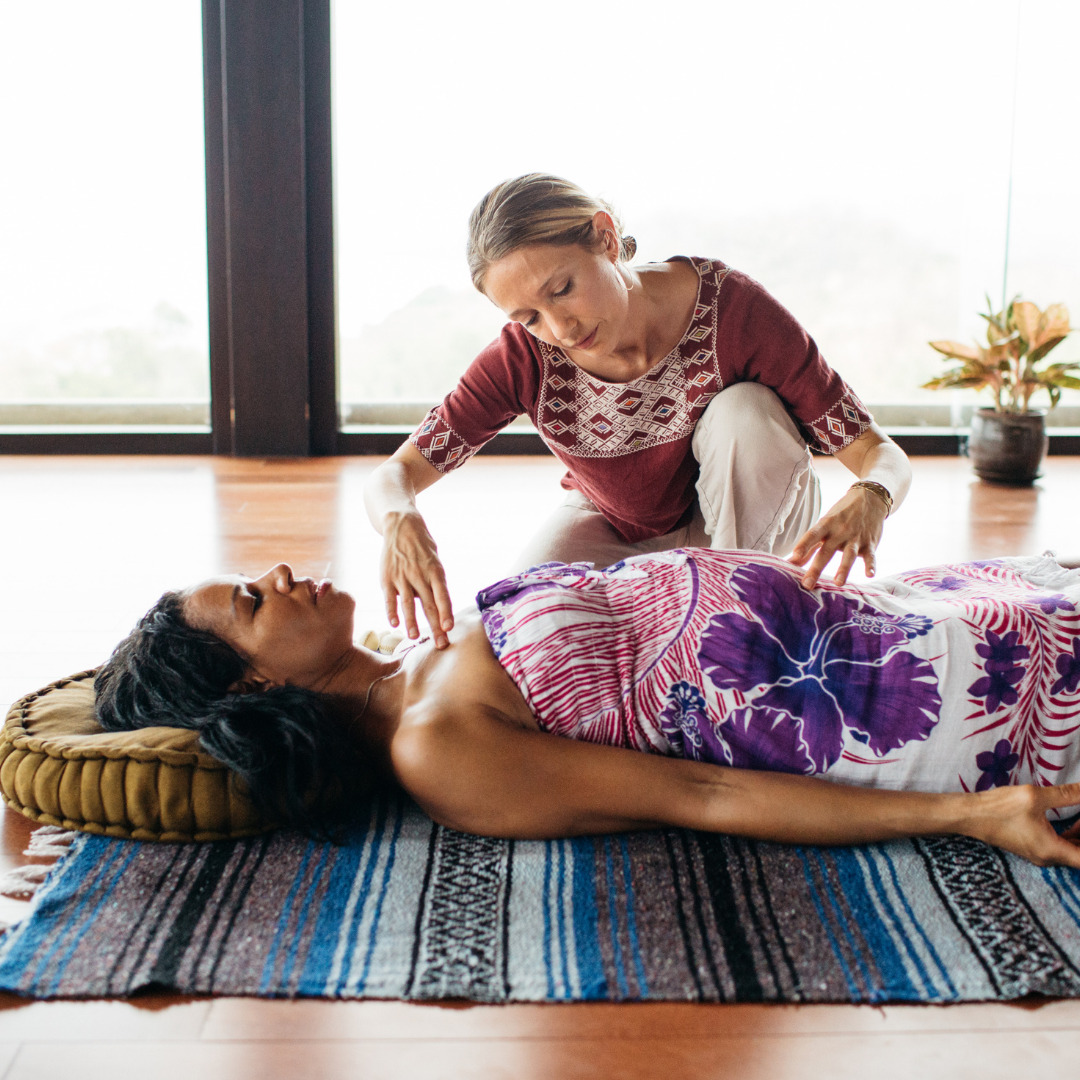
If you’re considering becoming a breathwork facilitator, adding breathwork to your work as a yoga teacher, therapist, coach, or simply deepening your own healing journey, these are the breathwork teacher training programs I’d recommend exploring.
I’ve researched dozens of trainings, experienced many facilitators firsthand, and personally trained with two of the programs below. This is a curated list of the schools that stand out for their integrity, depth, and ability to blend both science and spirituality.
If you’re new to the practice, I’d recommend reading our guide to the benefits of breathwork first.
What to look for in a breathwork teacher training program
Not all breathwork certifications teach the same approach.
Because connected, also known as circular breathwork can create powerful emotional, physical, and altered-state experiences, a quality training should teach far more than breathing techniques. Here’s a quick list of the key things a breathwork training program include:
- Trauma-informed facilitation
- Nervous system education
- Breath physiology
- Ethics and contraindications
- Practice hours with real clients
- Supervision and mentorship
- Integration skills after sessions
Having experienced many private and group breathwork sessions myself, I’m sharing the programs (below) that stand out because they honour both the science and the deeper transformational potential of the work.
Often compared to plant medicine , connected breathwork can create profound shifts in awareness. Learning to safely hold that kind of space is one of the most important parts of becoming a facilitator.
Five breathwork teacher training programs I’d recommend
Shanila Sattar’s Breathwork Facilitator Program
Created by Shanila Sattar, Flow Breathwork is a 12-week virtual facilitator certification that blends three-part circular breath, movement, energy healing, nervous system regulation, and embodiment practices rooted in ancient wisdom traditions. The training takes a trauma-informed, decolonized approach with a BIPOC lens, combining self-paced learning with live mentorship, practice pods, and integration calls. Students move through four phases covering breathwork history and science, emotional regulation, facilitation skills, soundscapes, and applied practice, while also receiving business training to help launch or grow a wellness practice.
What I appreciated most is her balance of what she calls “the science and the woo.” Students learn how to create grounded, safe containers while developing their own facilitation style.
Details and upcoming training dates here.
If you’re newly exploring your healing gifts, I also loved Shanila’s perspective in our last interview: How do you know if you’re a healer?
Tai Hubbert’s Breathwork Programs
Tai is one of the strongest educators I’ve found for understanding both the mystical and physiological sides of breathwork.
Her curriculum explores:
- Nervous system regulation
- Gas exchange during overbreathing
- Heart Rate Variability
- The vagus nerve
- Trauma-informed facilitation
- Expanded-state awareness
Tai’s approach emphasizes the importance of trauma-informed awareness and what it means to hold safer spaces for deep and expanded-state work.
Her Level One training is offered online, while Level Two becomes a more intimate residential experience with mentorship and hands-on facilitation practice.
If you’re looking for a training that emphasizes both evidence-based physiology and spiritual depth, this is a program worth exploring.
Learn more about Tai’s breathwork training programs here.
Amanda Asta’s Breathwork Teacher Academy
Amanda Asta’s Transcend Academy is one of the most comprehensive online breathwork certifications I’ve come across.
The 21-week, trauma-informed program combines:
- Breathwork facilitation
- Private one-on-one breathwork sessions
- Integration support
- Business coaching
- Marketing education
- Ongoing mentorship
What makes this program different is that it prepares students not only to become practitioners but also to build sustainable breathwork businesses.
Students begin with Level One, including private breathwork sessions designed to help future practitioners process and integrate their own experiences. The program then moves into facilitation skills, business education, and mentorship.
Details about the Transcend Breathwork Teacher Academy can be found here.
Transformational Breath Training with Judith Kravitz
If you’re interested in learning from one of the pioneers of modern breathwork, Judith Kravitz’s Transformational Breath training deserves a place on your shortlist.
Judith developed Transformational Breath more than four decades ago, and her methodology has become an established breathwork training pathway with practitioners around the world.
The training emphasizes:
- Full diaphragmatic breathing
- Breath analysis
- Body mapping
- Emotional release through the breath
- Hands-on facilitation
- Personal transformation alongside practitioner development
Unlike some newer certifications, Transformational Breath has an established lineage and a structured pathway that can continue into advanced facilitator training.
Learn more about Transformational Breath training with Judith Kravitz here.
Holotropic Breathwork
Holotropic Breathwork is another important lineage to explore if you’re interested in deep personal transformation, altered states of consciousness, and transpersonal psychology.
Developed by Stanislav and Christina Grof, the approach emerged in the 1970s and combines accelerated breathing with evocative music and a carefully held setting. Training is typically more intensive and experiential than many contemporary online certifications.
Holotropic Breathwork may be particularly interesting for therapists, psychologists, and practitioners drawn to consciousness work and the therapeutic potential of non-ordinary states.
Learn more about Holotropic Breathwork and training through the Grof Foundation.
How to choose a breathwork training
There’s no single breathwork certification that’s right for everyone. The modality, teaching style, format, length, cost, and level of mentorship can vary considerably.
Before investing in a program, I’d consider:
What style of breathwork do you want to facilitate?
Connected and circular breathwork, Transformational Breath, Holotropic Breathwork, and other approaches can have very different philosophies and techniques.
How much hands-on experience is included?
Reading about facilitation is very different from actually facilitating someone through a breathwork journey. Look for programs that give you plenty of opportunities to practice.
How much emphasis is placed on safety and contraindications?
Active breathwork can create significant physiological and emotional experiences. A good training should teach you when breathwork may not be appropriate and how to respond when difficult experiences arise.
Will you receive mentorship after the training?
Especially if you’re planning to work with clients, ongoing supervision and mentorship can be incredibly valuable as you develop your confidence and facilitation skills.
Does the approach resonate with you?
This one matters. You’ll be holding space for people through deeply personal experiences, so choose a teacher and methodology that genuinely align with your own values and way of working.
Frequently asked questions about breathwork training
How long does breathwork certification take?
It varies widely. Some introductory certifications can be completed over a weekend, while more comprehensive breathwork facilitator trainings take several months or include multiple levels of study. Many programs also require practice hours before certification.
How much does breathwork facilitator training cost?
The cost varies significantly depending on the school, format, number of training hours, and level of mentorship. Introductory programs may cost a few hundred dollars, while comprehensive certifications and multi-level programs can cost several thousand dollars.
Do I need to be a yoga teacher or therapist to become a breathwork facilitator?
No. People come to breathwork facilitation from many different backgrounds, including yoga, coaching, wellness, fitness, therapy, and other professions. What matters is choosing a training that provides thorough education, practical facilitation experience, and appropriate safety training.
What’s the difference between breathwork certification and breathwork teacher training?
The terms are often used interchangeably. A certification generally indicates that you’ve completed the requirements established by a particular school or methodology, while “teacher training” can refer to anything from an introductory facilitator course to a comprehensive professional program.
Is breathwork certification regulated?
There isn’t one universal licensing body or regulatory standard for breathwork facilitators. Training requirements vary by school and country, which makes it particularly important to understand what a program actually includes before enrolling.
Additional breathwork resources to explore
- Free guided breathwork meditations
- Where to practice breathwork online
- Our vetted breathwork practitioners
- Breathwork playlists
- The Benefits of breathwork
- Breathwork for business
If you’re considering breathwork as a career, I’d also recommend experiencing several different styles before committing to a training. The best way to understand how you want to facilitate is often to be on the other side of the breathwork journey first.